By Caleb Morgan
Updated November 2026
If you want to compare trail running shoes, the two categories that matter most are lightweight, low-profile models and max-cushion models with thicker midsoles. Lightweight trail shoes suit runners who cover well-groomed or moderately technical ground at a quick pace and want a firm, responsive feel. Max-cushion trail shoes suit runners on long, rocky or downhill-heavy routes who value shock absorption and underfoot protection over raw speed. The right pick depends mostly on terrain, distance and how your feet handle impact.
| Criterion | Lightweight Trail Shoe | Max-Cushion Trail Shoe |
|---|---|---|
| Typical stack height (heel) | Low to moderate; manufacturers often list roughly 20–25 mm | High; manufacturers often list 30 mm or more |
| Weight | Lighter; often under 9 oz for men’s standard sizes | Heavier; usually noticeably above lightweight models |
| Ground feel | Close to the trail, more responsive | More insulated, softer landing |
| Rock protection | Varies; some include a plate, many do not | Usually thicker midsole and often a rock plate |
| Traction | Often aggressive lugs on racing-oriented models | Deep lugs common, especially on wet or muddy designs |
| Best terrain | Smooth to moderately technical trails, fast efforts | Rocky, long, downhill-heavy or mixed routes |
Weight and Feel: Which Category Feels Faster?
Weight is the first thing most runners notice. Lightweight trail shoes generally win this round, and the gap shows up over distance. Owners often report that lighter shoes feel more natural on uphill surges and during tempo efforts, since there is less mass to lift with every stride. For a runner covering 40 miles a week on moderately rolling terrain, a shoe that saves a few ounces per foot can make the difference between tired legs and a comfortable finish.
Max-cushion models give up some of that snap. Their thicker foam compresses and rebounds more slowly, which many runners describe as a plush, cushioned feel. That softness pays off on descents, where it reduces the jarring that can build up in the quads over long hours.
Winner for weight and feel: lightweight trail shoes. If speed and responsiveness are your priorities, they are the better choice.
Cushioning and Rock Protection: Which Category Protects Better?
Protection is where max-cushion models clearly lead. A thicker midsole absorbs more impact from hard-packed dirt and loose stones, and many models in this category include a rock plate, a semi-rigid layer between the midsole and outsole that shields the foot from sharp objects. If you want a deeper explanation of how that plate works, see What Is a Rock Plate in Trail Running Shoes? A Clear Guide (2026).
Lightweight shoes can still offer protection, but it depends on the specific model. Some include a plate, and others rely on a thinner, firmer midsole to keep the foot stable on uneven ground. Runners who regularly step on sharp rock or run through rough, technical sections should check the spec sheet carefully before assuming a lightweight shoe will be enough.
Winner for cushioning and protection: max-cushion trail shoes. For rocky or long routes, the added padding and plate are worth the weight.
Traction: Which Category Grips Better?
Traction depends more on outsole design than on the overall category, but there are common patterns. Racing-oriented lightweight shoes often use aggressive lugs spaced to shed mud while keeping the sole flexible. Max-cushion shoes built for mixed or wet conditions frequently pair deep, widely spaced lugs with sticky rubber compounds.
Check the lug depth. Manufacturers commonly list lug depth in millimeters, and deeper lugs generally bite better into soft mud and loose gravel. Also look at lug pattern: closely spaced lugs tend to clear mud more poorly than widely spaced ones, while flat, shallow tread can slip on wet rock. If you run in snow or ice, consider dedicated winter options such as Trail Running Shoes Spikes: 5 Best Picks for Icy, Snowy Trails (2026).
Winner for traction: depends on the specific outsole. For wet, muddy routes, look for deep, widely spaced lugs in either category. Neither category wins outright.
Durability and Fit Range: Which Category Suits More Runners?
Max-cushion models tend to offer a wider range of fit options, including wide sizes, because their broader platforms accommodate more foot shapes. Runners with wider feet may find more choices here. If width is a concern, Trail Running Shoes Wide Fit: How to Choose the Right Pair (2026) walks through the sizing details.
Lightweight shoes usually run narrower and snugger, which suits runners who want a locked-in fit. Durability varies more by brand and foam type than by category, so check manufacturer notes on expected mileage and the materials used in the upper.
Winner for fit range: max-cushion trail shoes, mainly because they are more often offered in wide and extended size options.
Stability and Foot Type: Which Category Suits Your Stride?
Stride mechanics matter here. Runners who overpronate often need added support, which some max-cushion models supply through firmer medial posts or structured midsoles. Runners with a neutral stride may find lightweight shoes perfectly adequate. For detailed guidance, see Trail Running Shoes for Overpronators: 6 Best Picks for Every Trail (2026) and Trail Running Shoes for Underpronation: 6 Best Picks for Every Trail (2026).
Winner for stability: max-cushion trail shoes for most stability needs, though a qualified fitter or podiatrist can give a more reliable assessment. Consult a professional if you have a history of foot or ankle injury.
Which Should You Choose?
- Choose lightweight trail shoes if you race, run fast on smooth or moderately technical trails, or want a responsive, close-to-ground feel.
- Choose max-cushion trail shoes if your routes are rocky, long or downhill-heavy, or if you want more impact protection on tired legs.
- Choose lightweight shoes if you have a narrow foot and want a snug, locked-in fit.
- Choose max-cushion shoes if you need wide sizes or extra stability for overpronation.
- Choose a mid-range option if your terrain is genuinely mixed; many runners split the difference with moderate stack height and a light plate.
Picks for Each Option
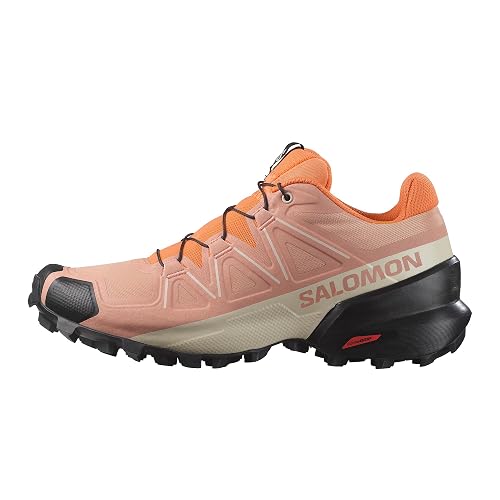
For a lightweight, responsive option, consider the Salomon Speedcross 6, a long-running trail model with aggressive lugs. View on Amazon
For a max-cushion, protective option, consider the Hoka Speedgoat 5, which manufacturers describe as a cushioned trail shoe built for long, varied routes. View on Amazon
FAQ
Are lightweight trail shoes good for beginners?
They can be, especially on smooth trails. Beginners who run rocky routes or cover long distances may find max-cushion models more comfortable as they build mileage.
Do max-cushion trail shoes slow you down?
Their extra weight and softer foam can feel less snappy on fast efforts. Many runners find the trade-off worthwhile on long or technical runs.
Do I need a rock plate?
Not always. A rock plate matters most on routes with sharp, exposed stone. On smooth dirt, many runners never notice the difference.
How do I know if a trail shoe fits correctly?
Aim for roughly a thumb’s width of space in front of your longest toe, and make sure your heel does not slip. Test shoes on a downhill slope if possible.
Can I use one pair for both road and trail?
Some runners do, but trail shoes are built for grip and protection that road running does not require. Using them on pavement is usually fine, but road shoes are generally better for hard surfaces.
Conclusion
When you compare trail running shoes, the main trade-off is speed and feel against protection and cushioning. Lightweight models suit fast, smoother runs, while max-cushion models suit long, rocky or mixed routes. Match the shoe to your terrain, distance and fit needs, and check the manufacturer’s specs for stack height, lug depth and width options before you buy.
Related reading
- Road vs Trail Running Shoes
- 11 Best Trail Running Shoes
- Zegama Trail Running Shoes: 6 Best Picks for Every Trail (2026)
About Caleb Morgan
Caleb Morgan is part of our editorial team and reviews and edits our running gear & races guides, checking product details against manufacturer specifications and owner feedback.